
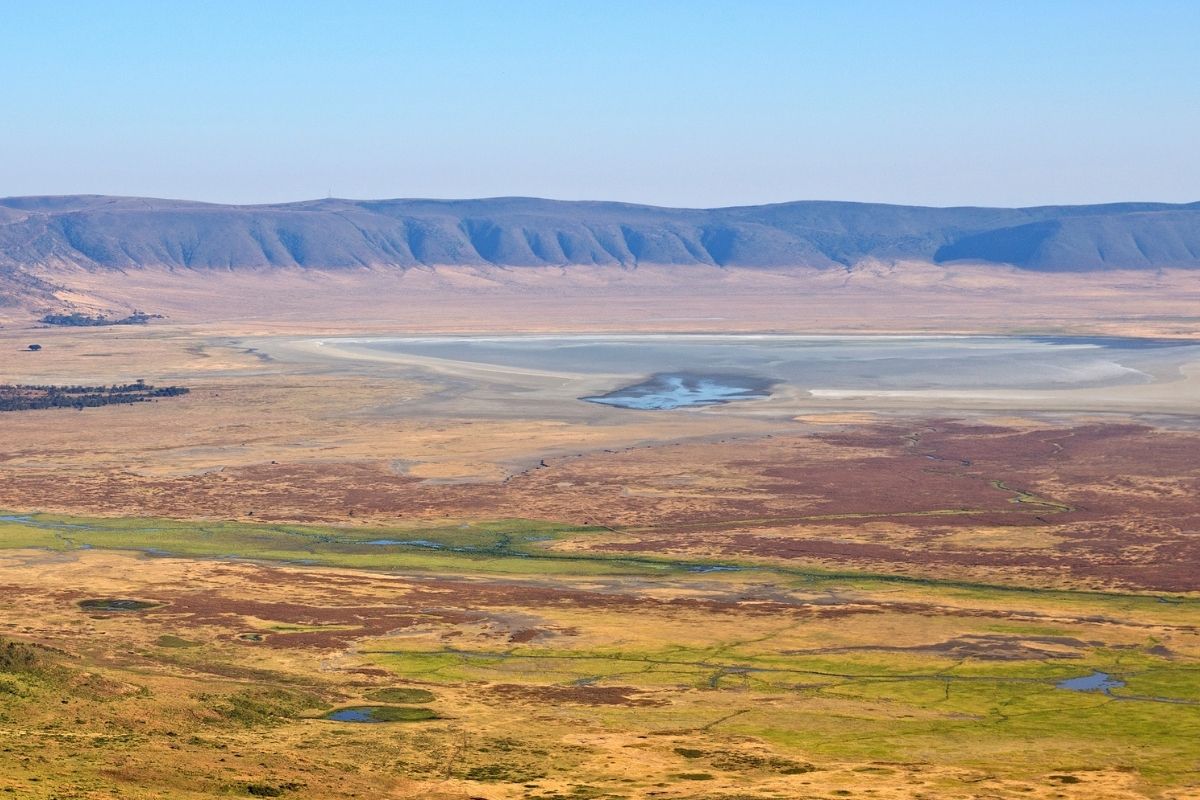
Ngorongoro Crater is the world’s largest intact volcanic caldera, spanning a whole 260-square-kilometre bowl walled in by 600-metre cliffs, one of the very few places on earth where you can realistically see all of the Big Five in a single morning, black rhino included.
It sits in northern Tanzania, a few hours from Arusha, and because the crater floor holds water year-round, its wildlife doesn’t migrate away.
That’s the short version: you can visit any month and see extraordinary game, but the dry season (June to October) gives you the easiest viewing and the best rhino odds.
Below is everything you’d actually want to know before you go, what lives down there, when to time your visit, what it costs, and how it fits into a wider safari.
Where is Ngorongoro Crater and what actually is it?
Ngorongoro is not a national park but a Conservation Area, a UNESCO World Heritage Site where wildlife, the Maasai and their cattle, geology and archaeology all share the same protected landscape. The famous crater is the centrepiece: the collapsed caldera of a volcano that, before it blew out roughly two to three million years ago, may have stood taller than Kilimanjaro.
What you’re left with today is a near-perfect natural amphitheatre. The rim sits at around 2,300 metres high, cool, often misty at dawn, and you descend a steep access road to a floor about 600 metres below, where the temperature climbs and the grassland opens up.
Inside are grass plains, a soda lake, patches of acacia and fever-tree forest, and freshwater springs. That variety of habitat packed into one enclosed space is the reason the game density is so abundantly high.
The wider Conservation Area also holds Oldupai (Olduvai) Gorge, one of the most important archaeological sites on the planet, where the Leakeys uncovered early-hominin fossils. If you have the time and the interest, it’s a worthwhile add-on that most crater visitors skip.
What animals will you see in Ngorongoro Crater?
The crater supports an estimated 25,000+ large animals in a remarkably small area, so sightings come thick and fast. Here’s what to expect, roughly in order of how reliably you’ll see them.
Black rhino – the crater’s signature animal
The crater is one of the last strongholds in East Africa where you have a genuine chance of seeing critically endangered eastern black rhino in the wild. The population is small and closely protected, so sightings are never guaranteed and are often distant, and this is where binoculars will come in handy, plus managing expectations, but few other single locations give you these odds. If ticking off the rhino is the goal of your trip, Ngorongoro is where you plan around it.
Lions, buffalo and elephant
Ngorongoro’s lion population is dense and used to vehicles, so you’ll often get close, unhurried sightings. Buffalo are everywhere, frequently in large herds. Elephants are present but with a twist worth knowing: the crater is famous for its old big-tusked bulls, which favour the Lerai fever-tree forest, while breeding herds tend to move between the crater and the surrounding highland forests. So you’ll likely see impressive lone bulls more than big family groups down on the floor.
Leopard
Leopard is the hardest of the Big Five here. They favour the forested rim rather than the open floor, so a crater-floor game drive isn’t your best shot at one. Seeing a leopard completes the set, but treat it as a bonus rather than an expectation.
Flamingos, hippos and others
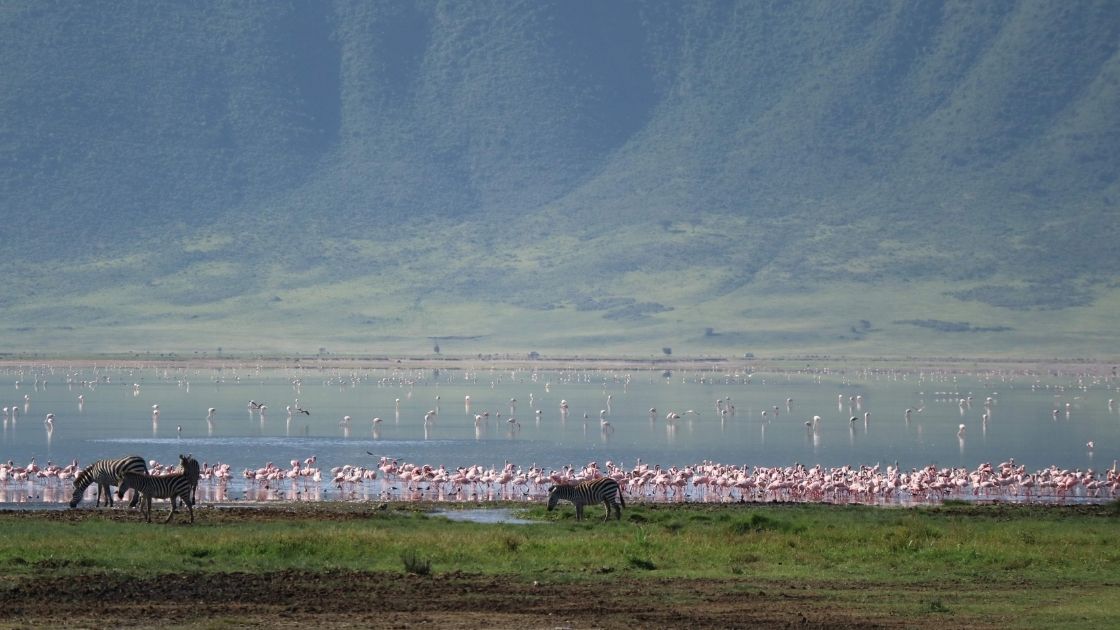
Lake Magadi, the shallow soda lake on the floor, draws flamingos, sometimes in pink-tinged masses, sometimes only scattered, depending on water and algae conditions. Around the freshwater springs and pools you’ll find hippos, while the plains carry wildebeest, zebra, Thomson’s and Grant’s gazelle, eland, warthog, and both golden and black-backed jackals.
Spotted hyena are common and often seen hunting, the crater is one of the better places in Africa to watch hyena behave as the capable predators they are, not just scavengers. Cheetah appear occasionally on the open grassland but are far from guaranteed.
The wider Conservation Area records over 500 bird species, so even outside the marquee mammals there’s plenty to hold a keen eye.
Can you really see the Big Five in one day at Ngorongoro?
Realistically, yes, with the honest caveat that leopard and rhino are the two that can let you down. On a good day with an early descent, four of the five (lion, buffalo, elephant, plus a rhino sighting even at distance) are very achievable, which is something you simply cannot say about most African parks.
The concentration is the whole point: because the animals are hemmed in by the crater walls and don’t migrate out, you’re not covering huge distances hoping to get lucky. You’re working a compact, wildlife-saturated floor.
What tends to kill the experience is not a lack of animals, but crowds and timing. More on that below.
When is the best time to visit Ngorongoro Crater?
Because the crater holds water and resident wildlife all year, there’s no “dead” season here the way there is in migration-dependent parks. But the seasons do change the experience.
Dry season (June–October): best overall game viewing
This is the classic window. Grass is shorter, animals are easier to spot, roads are firm, and rhino sightings tend to be better. The trade-offs: it’s peak season, so the crater floor gets busy with vehicles, and dawn on the rim is genuinely cold, think jacket, hat, layers you can peel off as the floor warms.
Green season (November–May): lush, quieter, better value
The short rains (roughly November–December) and long rains (roughly March–May) turn the landscape green and thin out the crowds. Birding is at its best as migrants arrive, newborn animals appear, and lodge rates often soften. The long rains can bring mud and the occasional washed-out track, so it’s the wetter gamble, but many travellers happily trade a bit of rain for fewer vehicles and lower prices.
Calving season (roughly January–February)
The southern plains of the Conservation Area, around Ndutu, host the wildebeest calving season, a spectacular period when hundreds of thousands of calves are born and predator action peaks. This happens in the wider Ndutu/southern Serengeti area rather than in the crater itself, but it’s within reach on the same trip and is a strong reason to consider a green-season visit if the migration drama appeals.
Bottom line on timing: come in the dry season for the cleanest game viewing and rhino odds; come in the green season for fewer crowds, lower cost, birds and calves. Either way, the single most important timing decision is the hour. Descend at or near gate-opening. The crater fills with vehicles as the morning wears on, and there are rules limiting how long vehicles can stay on the floor, so an early start buys you both better light and calmer, less-crowded sightings.
How much does it cost to visit Ngorongoro Crater?
Ngorongoro is one of the more expensive protected areas in Tanzania, and the fee structure trips people up because there are several separate charges. Here’s how it breaks down for international (non-East-African) visitors, based on the current tariff year.
- Conservation Area entry fee: around US$70 per adult per 24-hour period (children 5–16 discounted; under-5s free). This is charged whether or not you descend into the crater and it applies even to vehicles just transiting the area en route to the Serengeti.
- Crater descent (crater service) fee: around US$295 per vehicle, charged only if you actually drive down onto the crater floor. Crucially, this is per vehicle, not per person, and it’s valid for a single half-day entry and the cost is shared across everyone in the car.
- Camping fees (if applicable): public campsites start around US$30 per person; special/private campsites cost considerably more.
- Payment: electronic only via credit/debit card or approved mobile channels. No cash is accepted at the gate.
Two things worth stressing for buyers. First, these are just the park authority fees that don’t include your vehicle, guide, fuel, lodging or meals, which is why two safari quotes mentioning “the same Ngorongoro fees” can still differ wildly. Second, most reputable operators bundle these fees into the package price, so ask explicitly whether crater fees are included rather than assuming, and make sure you’re not being quoted resident rates by mistake.
How long do you need, and is one day enough?
For most travellers, one full day in the crater is enough to see the highlights, precisely because everything is concentrated. A typical visit is a single early descent, a morning of intensive game viewing, a picnic lunch near a designated spot (watch for cheeky kites and the hippo pool), and an ascent in the early afternoon.
That said, the Conservation Area rewards a second day if you have it: a morning revisiting the crater floor for a fresh shot at rhino or leopard, plus time for Oldupai Gorge or a Maasai cultural visit, turns a checklist stop into a fuller experience. If Ngorongoro is the anchor of your trip rather than a one-off, budget two nights on or near the rim.
Where should you stay near Ngorongoro Crater?
Broadly, you’re choosing between the crater rim and the Karatu area lower down, and it’s a real trade-off.
On the rim, you’re minutes from the descent road, so you can be first down in the morning, a genuine advantage for beating the crowds. The views straight into the crater are extraordinary. The cost is that it’s cold, often misty, and the premium rim lodges are expensive. Well-known rim options include Ngorongoro Serena Safari Lodge, Ngorongoro Sopa Lodge and the luxury &Beyond Ngorongoro Crater Lodge, among others.
Around Karatu, roughly 30–45 minutes from the rim, you drop in altitude to a warmer, greener farming belt with a wide spread of lodges and guesthouses at more forgiving prices. The trade-off is a longer, earlier drive to reach the gate. This is often the smarter choice for value-conscious travellers or anyone who feels the cold.
How does Ngorongoro fit into a wider safari?
Almost nobody visits the Ngorongoro only, and it’s rarely the best use of the crater to do so. It sits on Tanzania’s celebrated northern circuit, and the classic loops pair it with:
- Serengeti National Park: the natural big sibling, and the reason many itineraries pass through Ngorongoro anyway. A common pattern is Serengeti for the migration and open-plains predators, then Ngorongoro for the crater’s density and rhino.
- Tarangire National Park: famous for enormous elephant herds and baobab-studded landscapes, strong in the dry season.
- Lake Manyara National Park: a compact, birdy, tree-climbing-lion park that slots neatly into the drive.
For a traveller coming from Kenya, there’s a further option that most itineraries under-use: a cross-border Kenya–Tanzania safari, linking Kenya’s Amboseli or Maasai Mara with Tanzania’s northern circuit. Amboseli (elephants and Kilimanjaro views) and Ngorongoro (crater density and rhino) make a particularly complementary pair, since you’re seeing two completely different kinds of iconic landscape on one trip.
Sample Ngorongoro Itineraries
- 4 Days Tarangire & Ngorongoro Safari
- 5 Days Ngorongoro & Serengeti Safari
- 8 Days Serengeti, Ngorongoro & Zanzibar Safari
- 11 Days Tarangire, Serengeti, Ngorongoro, & Zanzibar Safari
What should you know before you go?
A few practical things that make or break a crater day:
- Dress for cold mornings. The rim at dawn is genuinely chilly and often foggy; the floor warms up fast. Layers you can shed are the answer.
- Go early. It’s worth repeating: an early descent means better light, calmer animals, and fewer vehicles crowding a sighting.
- Manage altitude gently. At 2,300 metres the rim can leave some people a little short of breath or poorly slept on the first night — nothing serious for most, but worth knowing.
- Keep expectations honest on rhino and leopard. They’re the two that can slip away. Everything else you’re very likely to see.
- Confirm what’s included. Crater fees, park fees and the crater service fee should all be spelled out in your quote so there are no surprises.
Frequently asked questions
Is Ngorongoro Crater worth it given the high fees?
For most first-time East Africa safari-goers, yes. The combination of Big Five potential, black rhino odds and sheer wildlife density in a single, scenically stunning bowl is something very few places on earth can match. If your budget is tight and rhino isn’t a priority, other parks offer more game-viewing hours per dollar, but Ngorongoro’s appeal is the concentration and the rhino.
Can you do Ngorongoro Crater as a day trip?
Yes. A single full day with an early descent covers the highlights well. Multi-day visits add cultural sites, Oldupai Gorge and a second crack at the harder sightings, but one day is a legitimate and popular option.
Is Ngorongoro better than the Serengeti?
They’re different, not ranked. The Serengeti offers vast open plains and the great migration; Ngorongoro offers unmatched density and rhino in an enclosed setting. The strongest itineraries include both rather than choosing between them.
Will I definitely see a black rhino?
Rhino sightings are never guaranteed and are often at a distance. But, Ngorongoro gives you among the best odds in East Africa. Bring binoculars, go early, and treat a sighting as a highlight rather than a certainty.
Do I need a 4×4 and a guide?
Effectively yes. The descent road and floor conditions call for a proper safari vehicle, and a knowledgeable guide dramatically improves what you find and understand, especially for locating rhino and reading animal behaviour.
Planning a trip that includes Ngorongoro?
If you’re weighing up how Ngorongoro fits with the rest of your East Africa safari, how many days, which season, and how to combine it with Kenya’s parks without overpaying or over-driving, that’s exactly the kind of thing we help travellers think through. Reach out for a straightforward, no-pressure plan built around what you actually want to see.
Fees and tariffs mentioned reflect the current Conservation Area schedule and can change each financial year.