
Choosing a safari operator comes down to four checks: confirm they hold a current government licence, read reviews on platforms that verify the traveller actually travelled, pay a deposit of 20–30% by credit card or PayPal rather than bank transfer, and insist on a written itemised quote naming every lodge. Those four steps take about 20 minutes and remove almost all of the risk from what is often a USD 5,000 to 10,000 purchase.
This matters more in East Africa than in most destinations, because the entry barrier to calling yourself a safari company is low, the deposits are large, and the booking happens from 8,000 kilometres away. The good news is that the verification trail is public in all four safari countries: Kenya, Tanzania, Uganda, and Rwanda.
Start with the licence, not the website
Every legitimate operator in Kenya, Tanzania, Uganda and Rwanda holds a government licence, and most also belong to a trade association. A good website costs USD 500 and proves nothing. A licence number you can check does.
| Credential | Country | What it is | How to check it |
|---|---|---|---|
| TRA licence | Kenya | Mandatory licence from the Tourism Regulatory Authority under the Tourism Act. Trading without one is illegal. | Ask for the licence number and confirm it with TRA at tra.go.ke |
| KATO membership | Kenya | Kenya Association of Tour Operators, around 300 members, all bound by a code of conduct. Requires a TRA licence plus one year of trading first. | Search the member directory at katokenya.org |
| TALA licence | Tanzania | Tourist Agents Licensing Authority licence. Regulations require comprehensively insured vehicles that display the operator’s name and the TALA licence. | Ask for the licence; on arrival, check the vehicle carries both markings |
| TATO membership | Tanzania | Tanzania Association of Tour Operators, established 1983, open to licensed operators only. | Check the member list at tatotz.org |
| UTB licence | Uganda | Uganda Tourism Board licence, required under the Uganda Tourism Act 2008. UTB registers every legitimate operator and publishes a directory. | Search the operator directory on the UTB website, and confirm the licence is active rather than suspended |
| AUTO membership | Uganda | Association of Uganda Tour Operators. Members sign a code of conduct. Other bodies include ESTOA, YUTO and the guides’ association USAGA. | Ask for the membership number and check it with AUTO |
| RDB licence | Rwanda | Rwanda Development Board tourism operating licence. Since a ministerial order took effect, every tourism entity including tour operators must hold one, after document checks and a physical inspection. | Ask for the licence and confirm with RDB |
| RTTA membership | Rwanda | Rwanda Tours and Travel Association, the main body for tour-operating businesses. Guides have their own association, RSGA. | Search the member directory of the Rwanda Chamber of Tourism at rcot.org.rw, which lists RTTA and RSGA members |
| Guide certification | Kenya | Kenya Professional Safari Guides Association grades guides bronze, silver and gold. | Ask which guide you are assigned and what grade they hold |
Ask directly: “Please send me your licence number and the name the company is registered under.” A real operator answers in one email. Hesitation, a change of subject, or a photograph of a certificate with the number blurred are all answers in themselves.
In Tanzania, a licensed operator must by law have suitable office premises and insured, marked vehicles. Many of the problems travellers report involve a middleman with neither, who takes the booking and then sells it on to whichever operator will run it cheapest.
The Uganda Tourism Board suspended the licences of 18 tour companies while investigating reports of fraud, and withdrew another operator’s licence in a separate action. That is the system working, but it only protects you if you check the register before you pay, since an operator’s website will not announce its own suspension.
Gorilla trekking adds one more check. In Uganda, an operator must be registered with the Uganda Wildlife Authority to buy gorilla, chimpanzee and golden monkey permits at all. If a company offers you gorilla permits, ask for the permit numbers and the names they are issued in once you have paid. Permits are issued to named individuals and are the single most common thing a fraudulent operator claims to have secured and has not.
Direct operator, overseas agent, or marketplace?
There are three ways to buy a safari, and they trade price against protection.
| Route | Typical cost | What you gain | What you give up |
|---|---|---|---|
| Direct with a licensed local operator | Lowest, no agent margin | Direct access to the people running your trip, flexibility, money stays in the local economy | You do the verification yourself; recourse is through Kenyan or Tanzanian bodies |
| Overseas tour operator or travel agent | 20–40% more | Consumer protection under your own country’s rules, a single point of contact in your time zone | Price, and a planner who may never have driven the route |
| Safari marketplace or booking platform | Between the two | Verified reviews, a shortlist of vetted operators, some dispute support | The platform usually cannot prevent fraud or recover a deposit; it connects, it does not guarantee |
Booking direct with a licensed local operator is both the cheapest and, once verified, a perfectly safe option. The risk is not “local” versus “international”, it is “licensed and verifiable” versus “not”. A great many unhappy travellers booked through a slick foreign-looking website that turned out to be a one-person broker.
The questions to ask before you pay anything
Send these in one email. How an operator answers tells you more than the answers themselves.
- What is your licence number and registered company name?
- Which exact lodges or camps will we stay in, by name, for each night?
- Are those lodges already booked, or will you book them once I pay?
- Is the vehicle private to our group or shared, and how many people maximum?
- Will the vehicle have a window seat for every passenger?
- Who is our guide, how long have they worked with you, and what certification do they hold?
- Exactly which park fees are included, and which are not?
- What is the deposit, when is the balance due, and what payment methods do you accept?
- What is your cancellation and refund policy in writing?
- What happens if a vehicle breaks down in the park?
- Can you give me two references from travellers who went in the last six months?
- Are you insured, and what does that cover?
Question 3 is the one most people skip and the one that most often goes wrong. A dishonest operator takes your deposit, books nothing, and uses later customers’ deposits to pay for your lodges, until the chain breaks. Ask for the lodge booking references and email one lodge directly to confirm you are in their system. Lodges answer these emails.
How to read reviews without being fooled
Reviews are useful, but only once you know what you are looking at.
- Prefer platforms that verify travel. A review tied to a confirmed booking is worth ten unverified five-star entries.
- Read the specific ones. “Amazing experience, highly recommend” tells you nothing. “They moved us to Mara North because the main reserve was busy, and explained why” tells you the operator thinks.
- Read the one and two-star reviews first. Every operator has some. What matters is the pattern and the response. An operator who replies factually to a bad review is a better bet than one with no bad reviews at all.
- Watch the dates. A cluster of glowing reviews in the same week, in similar English, is bought.
- Cross-check across platforms. Google, Tripadvisor and a safari marketplace should broadly agree. When one is spotless and the others are thin, trust the thin ones.
- Look for operational detail. How fast did the company respond when something went wrong? That is the only thing reviews measure that a brochure cannot fake.
Check out our Reviews on TripAdvisor
Protecting your money
This is where losses actually happen, and it is the easiest part to get right.
| Do | Avoid |
|---|---|
| Pay the deposit by credit card or PayPal, so you keep chargeback rights | Western Union, MoneyGram or any irreversible transfer |
| Deposit of 20–30%, balance due before or at the start of the trip | Full payment demanded months ahead with no explanation |
| Pay into an account in the registered company’s name | A personal account, or an account in a different country from the company |
| Keep every email, invoice and receipt | Agreeing anything important by voice call or WhatsApp voice note only |
| Take travel insurance that covers supplier financial failure | Assuming your standard policy covers an operator going bust |
Note the honest exception: it is normal industry practice in Kenya for full payment to be made before the safari begins, because the operator has to pay lodges and park fees in advance. That is not a red flag in itself. Full payment demanded at the enquiry stage, before an itinerary is confirmed, is.
Red flags
- A price far below everyone else. Government park fees are identical for every operator. If a quote undercuts the market by 40%, the saving is coming out of the vehicle, the guide, the lodges, or it is not a real quote.
- Pressure and urgency. “Three seats left, pay today.” Real operators hold space while you decide.
- No physical address, or an address that is a shared office with several company names.
- Payment to a personal account, or by irreversible transfer only.
- Vague pricing. A lump sum with no breakdown of park fees, accommodation and vehicle.
- Lodges named only as “similar category”. That phrase is where downgrades live.
- Refusal to provide references.
- Street or hotel-lobby approaches. Fake operators cluster around tourist hubs; in Arusha this is a documented and persistent pattern. Never pay a deposit to someone who approached you.
- The company trades under several names. Search the phone number and the email address, not just the brand.
- No social media history, or an account created three months ago.
What a trustworthy quote looks like
A quote you can rely on is boring and specific. It names every lodge, every meal basis, every park, and it separates what is fixed from what is the operator’s margin.
| A quote should state | Why it matters |
|---|---|
| Each night’s accommodation by name and room type | “Similar category” allows a silent downgrade |
| Park entry and conservation fees, itemised | These are published government rates you can verify yourself |
| Concession, crater or vehicle fees where they apply | The most common “extras” sprung on arrival |
| Whether the vehicle is private or shared, and its type | Decides the quality of your days more than the bed does |
| Meal basis per night, and whether drinks are included | Full board versus half board is a real cost difference |
| What is excluded: visas, tips, insurance, flights | Lets you build the true total, not the headline figure |
| Deposit, balance date, cancellation terms | Your only protection if plans change |
For what those fees should actually come to, see our breakdown of what a Tanzania safari costs. If a quote is wildly outside the published fee structure in either direction, ask why.
Judging the guide and the vehicle
These two determine your experience more than anything else you pay for, and they are the easiest things for an operator to quietly downgrade.
The guide. Ask for a named guide, not “an experienced driver-guide”. Ask how long they have worked with the company; a high turnover of freelance guides is a sign the operator competes on price alone. In Kenya, ask whether they hold a KPSGA certification. A good guide reads animal behaviour, positions the vehicle for light, and knows when to leave a crowded sighting. A cheap one follows other vehicles.
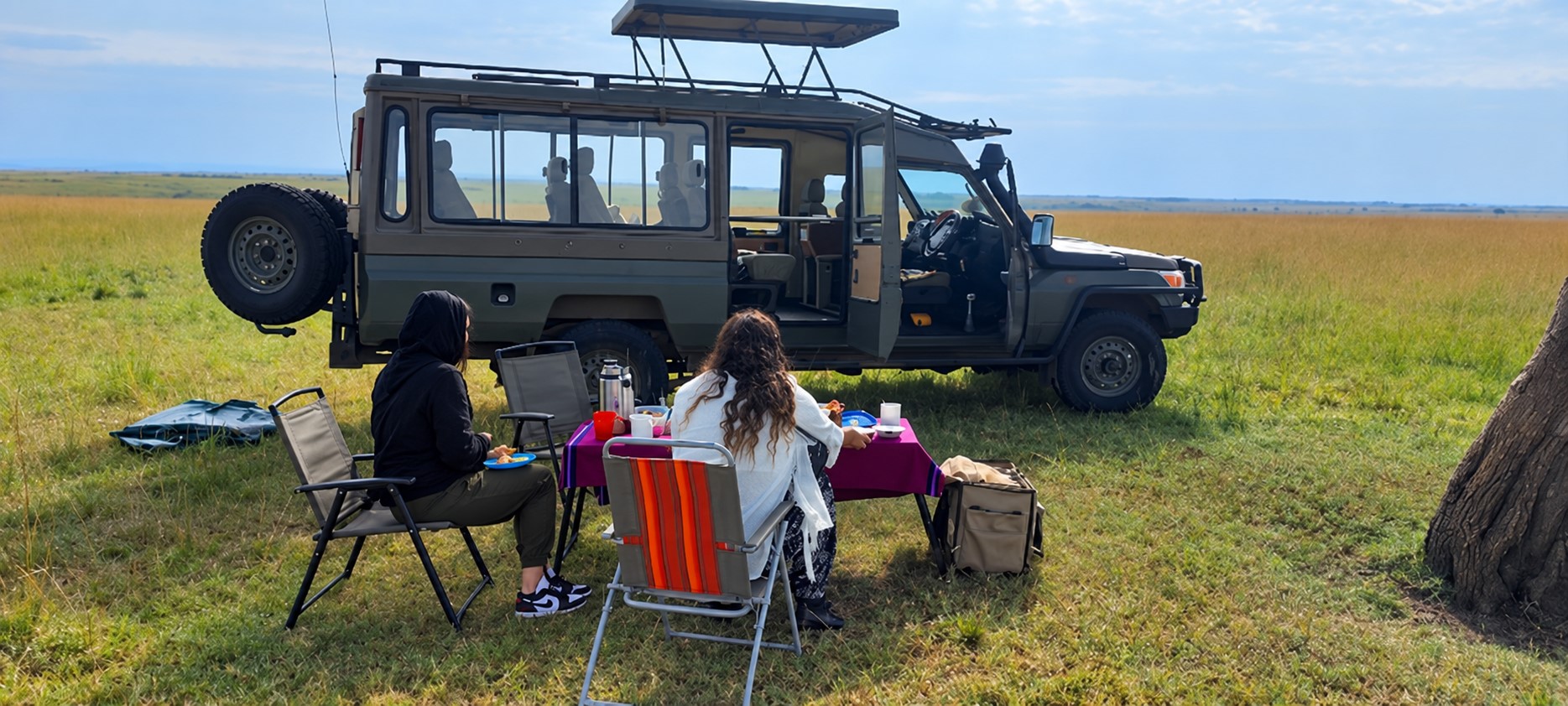
The vehicle. A purpose-built 4×4 with a pop-up roof, charging points, a fridge or cool box, and a window seat for every passenger. Ask how old the fleet is and whether the vehicles are owned or hired in. Operators who hire vehicles per trip have no control over condition, which is why so many complaints involve breakdowns. In Tanzania, the vehicle should visibly display the operator’s name and TALA licence.
If something goes wrong
- Raise it immediately and in writing. Most problems are fixable on the day. An operator who resolves a bad night quickly is doing their job.
- If a deposit vanishes, contact your card issuer or PayPal at once. Chargeback windows are limited, often 120 days, and run from the transaction date.
- Report to the regulator and the association. TRA and KATO in Kenya, TALA and TATO in Tanzania, UTB and AUTO in Uganda, RDB and RTTA in Rwanda. Associations can mediate disputes involving their members, and regulators can suspend a licence, which is one of the practical benefits of choosing a licensed member company.
- Report to the platform where you found the operator, and leave a factual review naming dates and amounts.
- Report to the tourist police in-country. Both Kenya and Tanzania have pursued operator fraud cases.
Common questions
Is it safe to book directly with a local African safari company?
Yes, provided the company is licensed and you verify that licence. Booking direct removes an agent’s 20–40% margin and puts you in contact with the people running your trip. The risk sits with unlicensed brokers, not with local operators as a category.
How much deposit is normal for a safari?
Typically 20–30%, with the balance due before the trip starts. Paying the full balance in advance is standard practice in Kenya because lodges and park fees are prepaid, but it should only happen after a confirmed itinerary naming your lodges.
How do I check if a safari operator is licensed?
Ask for the licence number and registered company name, then confirm with the regulator: the Tourism Regulatory Authority in Kenya, the TALA licensing authority in Tanzania, the Uganda Tourism Board, or the Rwanda Development Board. Then check the relevant association directory: KATO at katokenya.org, TATO at tatotz.org, AUTO in Uganda, or the Rwanda Chamber of Tourism directory at rcot.org.rw. Confirm the licence is currently active, not merely issued at some point.
What is a realistic price, and when is cheap too cheap?
Government park fees are fixed and identical for every operator, so they set a floor nobody can undercut. In Tanzania that floor is roughly USD 150–200 per person per day in the Serengeti and Ngorongoro. A quote close to or below the fee floor cannot be delivering what it promises.
Should I book through a marketplace or go direct?
A marketplace is a good place to research and shortlist, because the reviews are usually tied to real bookings. Most marketplaces are introducers rather than guarantors, so do the same licence and payment checks you would do anyway.
How far in advance should I book?
Six to nine months for July to September travel, three to four months otherwise. Booking early also gives you time to verify properly rather than deciding under pressure.
Does a nice website mean a company is real?
No. A professional website, good photography and an impressive itinerary cost very little. A verifiable licence number, a traceable registered company and named lodge bookings are the things that cannot be faked cheaply.
Talk to a licensed East African operator
Go Kenya Safari is a licensed Kenyan operator running private safaris across Kenya, Tanzania, Uganda and Rwanda, including gorilla trekking. We put our licence details, named lodges and an itemised fee breakdown in every quote, before you pay anything. Send us your dates and we will come back within 24 hours.