
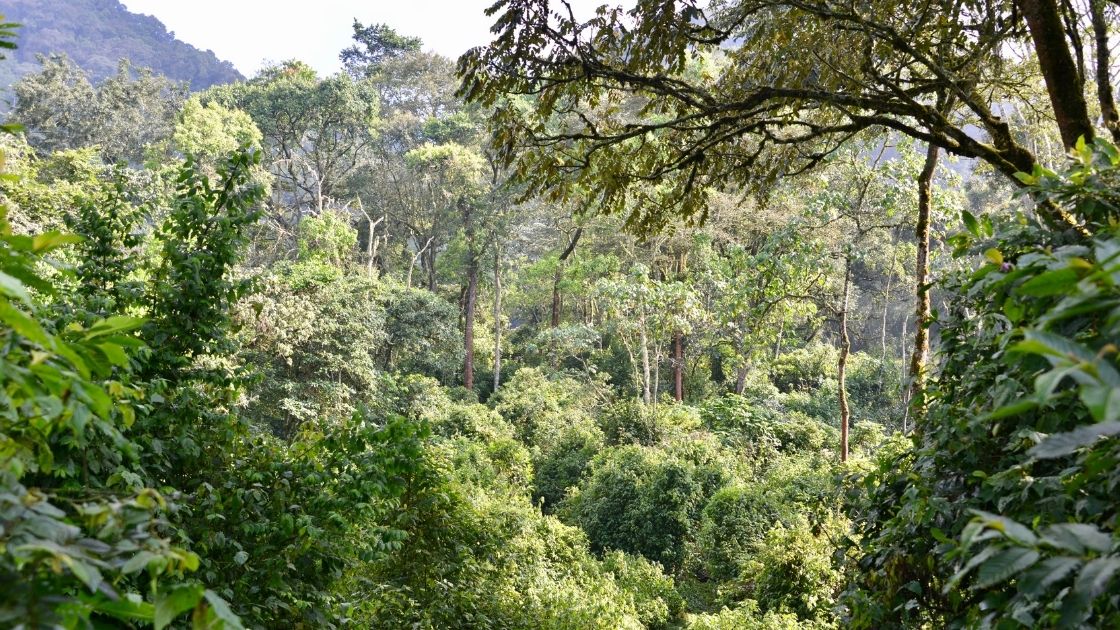
Bwindi Impenetrable Forest, in south-western Uganda, is the best place on earth to look a wild mountain gorilla in the eye. The park shelters roughly half of the world’s remaining mountain gorillas, and a permit buys you one carefully guided hour a few metres from a family in dense montane rainforest.
In 2026 that permit costs USD 800 for foreign non-residents, and you trek from one of four forest sectors. Below is the in-depth version of Bwindi, what the trek is really like, what it costs beyond the permit, which sector to choose, when to go, and why it is also one of Africa’s finest birding forests.
Where is Bwindi Impenetrable Forest, and how do you get there?
Bwindi sits in the far south-west of Uganda, along the edge of the Albertine Rift, close to the borders with Rwanda and the Democratic Republic of Congo. It’s an ancient rainforest, with parts of it are estimated to be over 25,000 years old, spanning across steep ridges and valleys between roughly 1,160 and 2,600 metres above sea level. “Impenetrable” is the undergrowth, genuinely thick, and that density is exactly why the gorillas thrive here.
There are two ways into the forest:
- By road from Entebbe or Kampala, a drive taking around 8 to 9 hours, usually broken into two days with a stop at Lake Mburo or the equator. Though long, the landscapes through the south-west highlands are some of the most beautiful in Uganda.
- By air, by scheduled and charter flights that run to Kihihi or Kisoro airstrips, roughly an hour from Entebbe, then a short transfer to your sector. Fly-in costs more but saves the best part of two days each way.
Many travellers combine Bwindi with Rwanda, because Kigali is only 4 to 5 hours by road from the southern sectors, often quicker and smoother than driving down from Kampala. If gorillas are the priority and time is tight, entering via Kigali and trekking in Bwindi is a well-worn, sensible route.
Why trek gorillas in Bwindi specifically?
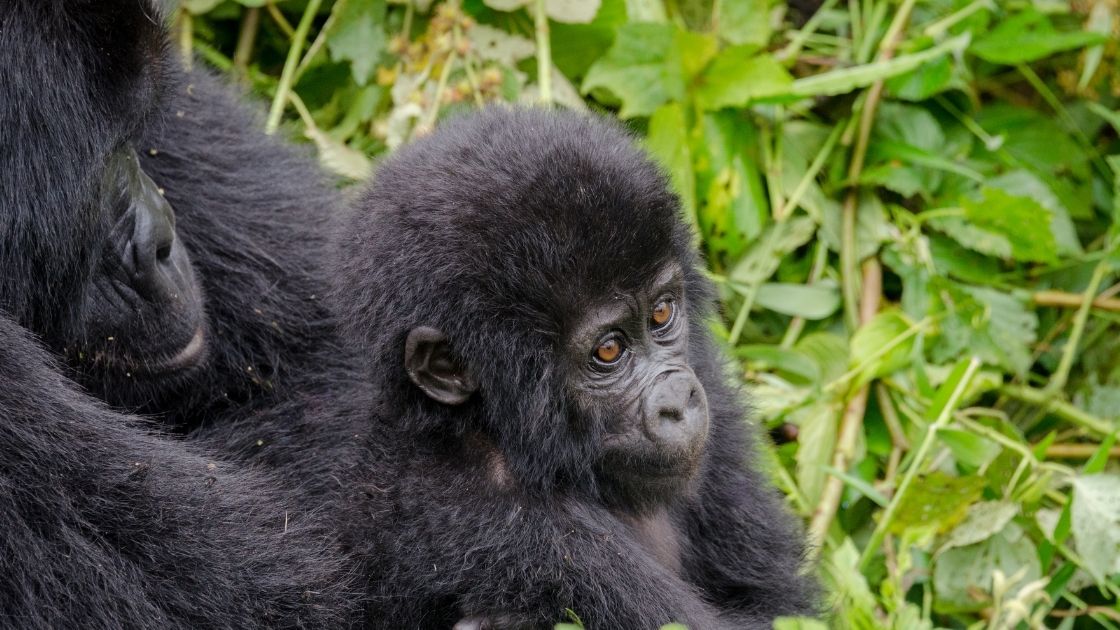
Bwindi and the neighbouring Sarambwe reserve hold about half of the world’s last mountain gorillas, with a global population that today numbers only just over a thousand animals. The park is a UNESCO World Heritage Site, listed both for that gorilla population and also for being one of the most biodiverse forests in East Africa.
Bwindi also gives you more choice than anywhere else. It has more than 20 habituated gorilla families spread across four sectors, which means more daily permits and a better chance of matching a group to your fitness and travel dates. Uganda’s other gorilla park, Mgahinga, has just one habituated family and permits there are often unavailable, so for almost every traveller, “gorilla trekking in Uganda” effectively means Bwindi.
And unlike the more open volcano slopes across the border in Rwanda, trekking here happens inside a true forest: tangled, steep, wet underfoot, alive with birdsong. Some people find that atmosphere the whole point.
How much does a Bwindi gorilla permit cost in 2026?
The permit is the single largest fixed cost of the trip, one permit per person, per trek. As of 2026, the Uganda Wildlife Authority (UWA) sets these rates:
- Standard gorilla permit: USD 800 per person (foreign non-resident). Buys one hour with a habituated family, plus rangers, trackers and security.
- Low-season permit: USD 600 per person, for treks in April, May and November (a discount introduced in early 2026). These are the wet months, hence a cheaper permit and a muddier trek.
- Foreign resident: USD 700.
- East African citizen: around USD 80 (paid in local currency).
- Gorilla habituation experience: USD 1,500. Four hours (not one) with a family still being habituated, available only in the Rushaga sector, limited to four people per day.
Two important 2026 rule changes to plan around:
- Full payment at booking. Pay for the permit in full to lock a permit. It is therefore advisable to confirm your flights and dates before you commit.
- You book a sector, not a family. You reserve a permit for one of Bwindi’s four sectors; your specific gorilla group is assigned on the morning of the trek at the briefing.
What the permit does not cover. The permit is one line item; you still need to budget for accommodation (roughly USD 100 per night for simple lodges up to USD 400+ for luxury near the trailheads), transport to and from Bwindi, meals, a guide, and tips for porters and trackers. A realistic all-in cost for a short gorilla trip, permit, lodge, transfer and guiding, typically lands in the low thousands of dollars per person rather than the USD 800 headline. We’d rather tell you that now than have it surprise you later.
Book early. In peak seasons (June to September, December to February), the eight daily permits per family sell out months ahead. Consider a three to six months of lead time, longer is safer.
What are Bwindi’s four sectors, and which one should you choose?
Bwindi is trekked from four separate sectors, each with its own trailhead, gorilla families, terrain and lodges. Choosing the right one matters more than most first-timers realise, because it shapes both the difficulty of your hike and where you’ll sleep.
Buhoma (North)
The original and best-known sector, with the widest range of lodges and generally gentler trails. If it’s your first gorilla trek, you value comfort, or you’re travelling with less mobile companions, Buhoma is the safe, classic choice.
Ruhija (East)
Higher and cooler, at altitude on the eastern side. It’s quieter than Buhoma and a favourite of birdwatchers since the road to Ruhija passes through some of the park’s richest birding stretches. Treks can be demanding given the elevation.
Rushaga (South)
Home to the most habituated families of any sector, which means the most permits and the best odds of last-minute availability. Rushaga is also the only place to do the four-hour habituation experience. A strong pick if you want choice and flexibility.
Nkuringo (South)
The most scenic and the most physically demanding. The views over the forest and toward the Virunga volcanoes are spectacular, but the trails are steep and athletic. Choose Nkuringo if you’re fit and want the dramatic version of the day.
Rule of thumb: Buhoma or Ruhija for comfort and easier access; Rushaga for the most families and habituation; Nkuringo for fitness and views. Your accommodation should be booked in the same sector as your permit. It’s not practical to cross sectors on trek morning.
What is gorilla trekking in Bwindi actually like?
The day starts early. You arrive at your sector’s ranger station around 7:30–8:00 a.m. for a briefing, where you’re assigned a family and grouped with up to seven other trekkers, a maximum of eight visitors per gorilla family per day. Advance trackers have often been out since dawn locating the group, which is why the success rate for actually finding gorillas sits well above 95%.
You then walk into the forest. And this is the honest part: the trek can take anywhere from 30 minutes to a full, hard day. Gorillas move overnight, so you go where they are. Terrain is steep, muddy, and dense. You’ll climb, scramble, and push through vegetation. Distances range from about one kilometre to ten. Fitness helps enormously, but so does managing expectations.
When you reach the family, the clock starts on your one hour. You’ll keep a set distance (rangers enforce it strictly for the gorillas’ health), stay quiet, and watch a silverback, mothers and juveniles go about their day, often close enough to hear them breathe. Most people describe it as the most extraordinary hour of their travelling lives.
Uganda Gorilla Trekking Tours
- 4 Days Bwindi Gorilla Trekking from Entebbe
- 6 Days Gorilla & Chimpanzee Tracking
- 9 Days Gorilla Trekking & Wildlife Safari
How fit do you need to be?
Fitter than for a typical safari, but this is not mountaineering. Trekkers in their 60s and 70s complete it regularly. Two things make the difference: you can request a family matched to your fitness level at the briefing, and you can, and should, hire a porter. A porter carries your daypack, gives you a hand on steep sections, and puts money directly into the local community. It’s one of the best few dollars you’ll spend on the trip.
What are the rules with the gorillas?
They exist to protect the animals, and rangers do not bend them. Expect a required minimum distance, a hard one-hour limit, no trekking if you’re visibly ill (these are our closest relatives and vulnerable to human disease), no flash photography, and no eating near the family. A minimum age of 15 applies to trekking.
Beyond gorillas: what else lives in Bwindi?
If gorillas are the headline, Bwindi’s biodiversity is the reason serious naturalists keep coming back. This is one of the richest forests in East Africa, and for birders it’s close to a pilgrimage.
Birdlife
Bwindi is one of the best birding sites on the continent, with well over 300 recorded species, including a remarkable concentration of Albertine Rift endemics, birds found nowhere outside this narrow strip of Africa. The much-wanted African green broadbill is a Bwindi speciality, and the Ruhija sector and the “Neck” section of forest are legendary among birders. Even non-birders notice it: the forest is genuinely loud with birdsong at dawn.
Other primates and wildlife
Beyond gorillas, Bwindi holds chimpanzees, several monkey species (including the striking L’Hoest’s monkey), forest elephants (rarely seen but present), duikers, and hundreds of butterfly species. You won’t see plains game, but the diversity underfoot and overhead is extraordinary.
This is worth understanding before you book: Bwindi is a forest experience, not a Big Five one. If you want gorillas and classic game viewing, the natural move is to pair Bwindi with a savannah park like Queen Elizabeth in Uganda, or the Kenyan and Tanzanian parks, as part of a longer East Africa trip.
See our Kenya and Uganda Safaris
When is the best time to visit Bwindi?
Bwindi is trekkable year-round. Being a rainforest, there’s no truly dry month.
- Drier seasons: June to September and December to February. These are the most popular months. Trails are firmer, treks are generally easier, and photography is better. This is peak season, so permits and lodges must be booked far ahead.
- Wetter seasons: March to May and October to November. Heavier rain means muddier, more slippery, harder trekking, but promises fewer crowds, lush green forest, and, in April, May and November, the discounted USD 600 permit. If you’re fit, on a budget, and don’t mind mud, low season is a genuinely smart play.
The best recommendation: if this is a once-in-a-lifetime trip and comfort matters, go in the dry season and book early. If you’re hardy and value-driven, the wet-season discount months offer the same gorillas for less money and a quieter forest.
What should you pack for a Bwindi trek?
Rainforest trekking has non-negotiable kit. At minimum: sturdy, well-worn waterproof hiking boots; long trousers and long-sleeved shirts (tucked in; the forest has stinging nettles and insects); gardening or trekking gloves for grabbing vegetation; a good rain jacket; gaiters if you have them; insect repellent; and a daypack with plenty of water. Break your boots in before you travel. This is not the place for new footwear.
Is gorilla trekking in Bwindi worth it and ethical?
On worth: almost everyone who does it says yes, unreservedly. It is expensive, it can be physically hard, and the hour is short, and it is still, for most people, the highlight of their entire time in Africa. Few experiences are a substitute for it.
On ethics, the picture is genuinely reassuring, which is not something we say lightly. Permit fees are the backbone of mountain gorilla conservation, and a share is channelled to the communities living around the park, the direct link between tourism income and gorilla survival is one of Africa’s clearest conservation success stories. The strict rules (limited group sizes, distance requirements, health screening, no visits when ill) exist precisely to keep the animals safe from the diseases and pressures that tourism could otherwise bring. Trekking responsibly is part of what keeps these gorillas alive.
Frequently asked questions
How much does gorilla trekking in Bwindi cost in 2026?
The permit is USD 800 per person for foreign non-residents (USD 600 in the discounted low-season months of April, May and November), USD 700 for foreign residents, and around USD 80 for East African citizens. A four-hour habituation permit in Rushaga is USD 1,500. The permit is separate from accommodation, transport, meals and guiding, so a full short trip usually costs several thousand dollars per person.
How difficult is the Bwindi gorilla trek?
It ranges from moderate to strenuous. Treks last from about 30 minutes to a full day over steep, muddy, dense terrain, depending on where the gorillas moved overnight. You can request a family matched to your fitness at the morning briefing, and hiring a porter makes a big difference. Trekkers in their 60s and 70s do it regularly.
Is Bwindi or Rwanda better for gorilla trekking?
Both offer the same one hour with mountain gorillas. Uganda’s Bwindi wins on price (USD 800 versus Rwanda’s USD 1,500) and has more habituated families and permits. Rwanda’s Volcanoes National Park is easier to reach from Kigali and has more open volcano scenery. Many travellers get the best of both by flying into Kigali and trekking in Bwindi.
How far ahead should I book a Bwindi permit?
Three to six months for peak seasons (June–September, December–February), and longer is safer. Only eight permits are issued per gorilla family per day, and since 2026 permits must be paid in full at the time of booking, so confirm your travel dates first.
What’s the best time of year to trek in Bwindi?
The drier months, June to September and December to February, offer firmer trails and easier trekking, but are busiest. The wetter months are harder underfoot but quieter, and April, May and November carry the discounted USD 600 permit. Gorillas are seen year-round.
Planning your Bwindi gorilla trek
Planning a gorilla trek in Bwindi? We can help you choose the right sector and season, get the permit logistics right, and slot Bwindi into a wider East Africa trip that’s genuinely built around what you want to see. Tell us your dates and we’ll take it from there.