
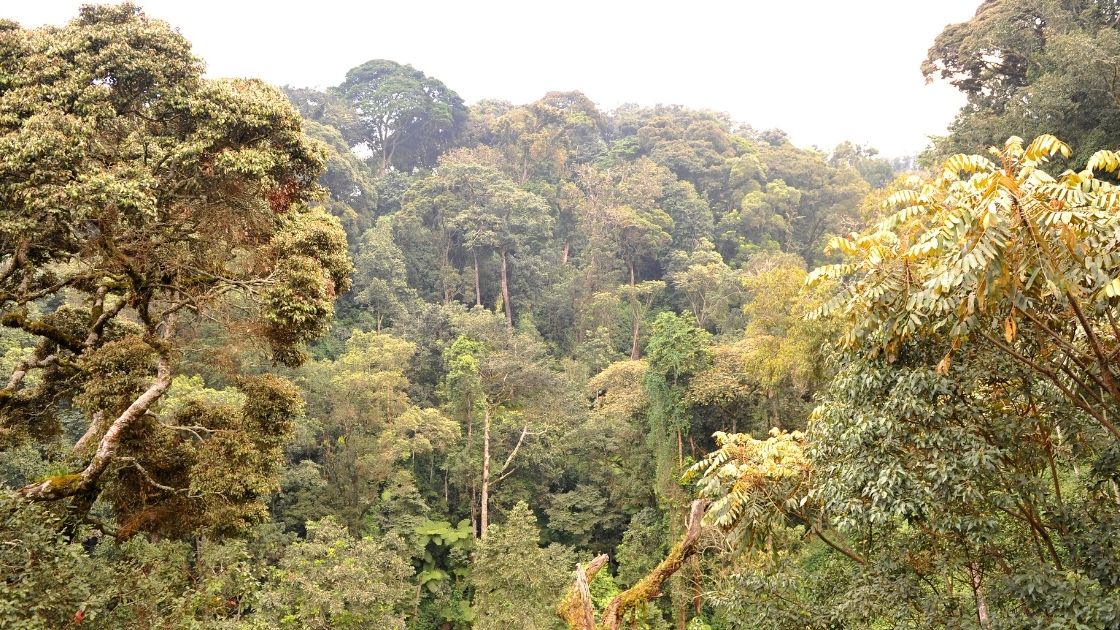
Nyungwe National Park in southwestern Rwanda is East Africa’s premier rainforest destination, best known for two things: chimpanzee tracking and a suspended canopy walkway that carries you 50–70 metres above the forest floor. It’s one of Africa’s oldest and largest montane rainforests, home to around 1,000 chimpanzees, 13 primate species in total, and more than 300 bird species. If you want to stand eye-level with wild chimps in the morning and walk through the treetops in the afternoon, Nyungwe is the one park in the region where you can do both in a single day.
This guide covers what the experience is actually like, what it costs, when to go, how to get there, and who it is for.
What is Nyungwe National Park known for?
Nyungwe protects roughly 1,015 square kilometres of unbroken montane rainforest along Rwanda’s border with Burundi. It’s often described as one of the oldest rainforests in Africa, which is part of why its biodiversity is so dense.
Most visitors come for the chimpanzees. Nyungwe holds one of the largest chimpanzee populations in East Africa, with several habituated groups cleared for tourism. But the park’s second signature is just as memorable: the canopy walkway is one of very few of its kind on the continent, and the only one in East Africa. Add 13 primate species, over 300 birds (including around 26–29 Albertine Rift endemics found almost nowhere else), waterfalls, tea-covered hills and a network of marked hiking trails, and Nyungwe rewards a two- or three-night stay far more than a rushed overnight.
Unlike the savannah parks most people picture when they think “African safari,” Nyungwe is a walking, listening, looking-up kind of place. Hear a troop of colobus crashing through the canopy, catch a turaco’s flash of crimson, and, if the tracking goes your way, sit quietly while a chimpanzee grooms another a few metres away.
What is chimpanzee tracking in Nyungwe actually like?
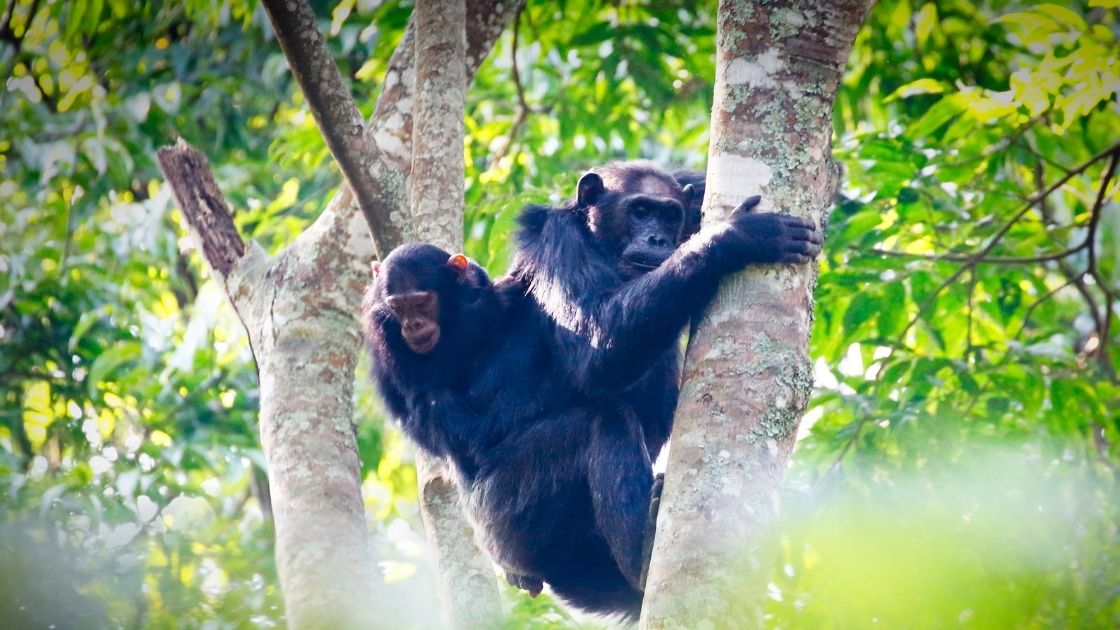
Chimpanzee tracking is the headline activity and the main reason most travellers make the long trip southwest. It’s a guided, early-morning trek on foot, led by park rangers who radio ahead with the trackers who locate the group first.
You’ll report to the visitor point before dawn, where briefings typically start around 5:00 AM, because chimps are most active and easiest to find early, before they move deep into the forest to feed. From there, the trek can last anywhere from one to six hours depending entirely on where the chimps are that day. This is wild tracking, some mornings the group is close to the trail, other mornings you climb.
How difficult is the trek?
Harder than a canopy walk, easier than gorilla trekking in Volcanoes, but the chimps move fast and high. Where gorillas graze slowly on the ground, chimps travel through the canopy, which means once located you may need to move quickly along uneven, sometimes steep and muddy forest floor to keep them in view. A reasonable level of fitness helps. The two main tracking areas are around Uwinka (the central park headquarters) and Cyamudongo, a separate forest fragment often cited as having a higher success rate for close encounters.
How close do you get, and what are the rules?
Once your group finds the chimps, you’re allowed one hour with them. Group sizes are capped at eight trekkers per chimpanzee group to limit stress on the animals. The minimum age for chimpanzee tracking is 16. You’ll be asked to keep a set distance and wear a mask in some cases, because chimps share enough of our DNA to catch human respiratory illness, the same conservation logic that governs gorilla trekking.
One honest expectation to set: chimp sightings are less predictable than gorilla sightings. Gorillas stay put; chimps roam. Most trekkers do connect with the group, but the encounter can be higher in the canopy and more fleeting than the serene, ground-level gorilla experience. Go for the thrill of the tracking and the forest itself, and a great sighting becomes a bonus rather than the sole measure of the day.
What is the Nyungwe canopy walk, and is it scary?
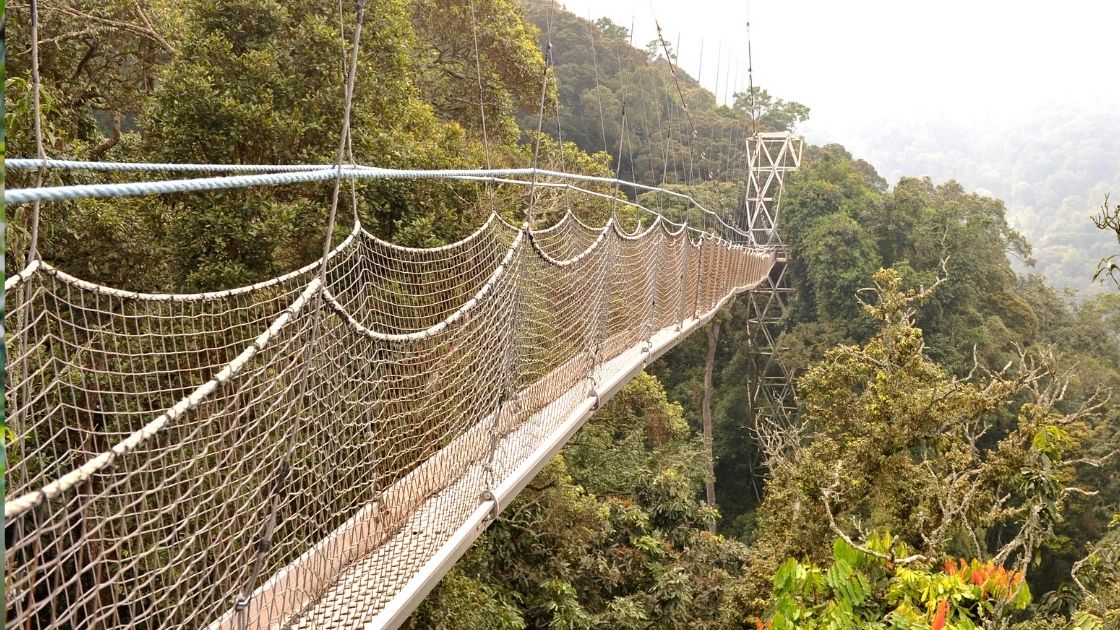
The canopy walk is Nyungwe’s second big draw and, for many visitors, the more photogenic one. It’s a suspended bridge, roughly 160 metres long and hanging 50 to 70 metres above the forest floor, that lets you walk through the treetops and look down into a rainforest that most people only ever see from below.
You reach the bridge via the Igishigishigi Trail, a short forest hike of around two kilometres from the Uwinka Visitor Centre. There are a few steep sections, but it’s manageable for first-time hikers and even for children (minimum age is generally 6, accompanied by an adult). The full experience takes around two hours including the walk in and out, and sessions run at set times through the day, commonly 8:00 AM, 10:00 AM, 1:00 PM and 3:00 PM.
Is it scary? The bridge sways gently and you can see straight down through the treetops, so anyone with a genuine fear of heights should think twice. For everyone else, it’s more awe than adrenaline. On a clear day the views stretch across the forest canopy toward the hills of Lake Kivu and, in the distance, the Virunga volcanoes. Go in the morning for the best light and the least mist.
What else is there to do in Nyungwe?
Nyungwe rewards travellers who slow down. Beyond the two headline activities, the park offers:
- Colobus monkey tracking. Nyungwe is famous for enormous troops of Angola colobus, sometimes several hundred moving through the canopy together, one of the largest primate super-groups in Africa.
- Birding. With 300-plus species and around 26–29 Albertine Rift endemics, Nyungwe is one of the finest birding forests in East Africa. Great Blue Turaco, Rwenzori Turaco and Red-collared Babbler are among the sought-after sightings.
- Guided nature trails. The park has a network of marked trails, the Isumo Waterfall Trail and the Kamiranzovu Marsh Trail are popular half-day walks, ranging from gentle to demanding.
- Night walks. A guided after-dark walk to spot nocturnal species and the forest’s smaller residents.
- Tea experiences. Nyungwe is ringed by tea estates, and a plantation visit pairs naturally with a stay, offering a look at the local economy that borders the forest.
This mix is exactly why Nyungwe deserves more than a single night. Two full days lets you trek chimps one morning, do the canopy walk and a colobus tracking or waterfall trail on another, and still have time to slow down.
When is the best time to visit Nyungwe?
The short answer: the dry seasons, roughly June to September and December to February, offer the best trail conditions and are the most reliable months for chimpanzee tracking. Drier ground means easier, safer hiking and chimps that are easier to reach.
But Nyungwe is a rainforest, so “dry” is relative, expect rain at any time of year, and pack for it regardless of season. The trade-offs are worth understanding.
Dry season (June–September, December–February)
Firmer trails, easier tracking, better canopy-walk visibility, and the busiest period, so book permits and lodges ahead, especially over weekends and holidays. This is the peak window and the safest bet for a first visit.
Wet season (March – May, October – November)
The forest is at its lushest and greenest, birding is often superb, and there are fewer visitors. The trade-off is muddier, more slippery trails, and a higher chance of a wet trek. If you don’t mind serious rain gear and a tougher walk, the low season can be quieter and beautiful.
A useful point in Nyungwe’s favour: unlike migration-driven savannah parks, the chimps and other primates don’t leave. Nyungwe is genuinely a year-round destination, you’re choosing between trail comfort and crowd levels, not between “wildlife” and “no wildlife.”
How much does Nyungwe cost?
Nyungwe’s activity fees are set by African Parks (the Nyungwe Management Company), which took over park management in 2020. That’s worth knowing, because many travel sites still quote older figures from when the Rwanda Development Board ran the park, one reason you’ll see wildly different numbers online. Prices are also tiered by residency (international non-resident, foreign resident in East Africa, and East African citizen), which is another source of confusion.
Here are honest current ranges for international (non-resident) visitors. Treat these as planning figures and confirm the exact rate with your operator when you book, as park fees are reviewed periodically:
- Chimpanzee tracking permit: in the region of US$150 per person for international visitors (some sources still quote up to $250 from the previous management era). The permit includes your ranger guide and park entry for the day.
- Canopy walk: around US$40 per person for international visitors (older listings show $60), plus park entry if not already covered by another activity that day.
- Other guided activities (colobus tracking, birding, nature trails, night walks): generally in the US$40 per activity range for international visitors.
- Porters and freelance guides: roughly US$10–25 per day — a small cost that supports the local community and is well worth it on a muddy trek.
Beyond park fees, your two biggest costs will be accommodation and transport to this remote corner of Rwanda, covered below. Building a realistic Nyungwe budget means adding permits + lodging + the long transfer from Kigali (or a charter flight), not just the permit price you see quoted online.
How do you get to Nyungwe?
Nyungwe sits in Rwanda’s far southwest, which is both its charm and its logistical challenge. There are two main ways in:
By road from Kigali
The drive from Kigali is around 5 to 6 hours on generally good tarmac, winding through the terraced hills that give Rwanda its “Land of a Thousand Hills” nickname. It’s a scenic drive, but a long one, most travellers break the journey or plan an overnight rather than attempting Nyungwe as a day trip (which isn’t realistic).
By air
For those short on time, charter flights run to the Kamembe airstrip near Rusizi, roughly 35–45 minutes from the park, cutting the long road transfer down dramatically. This is the faster but pricier option and is usually arranged as part of a wider itinerary.
Combining Nyungwe with the rest of Rwanda
Nyungwe is most naturally paired with Volcanoes National Park in the north for gorilla trekking, and with Lake Kivu, which lies between the two and makes an ideal, relaxing midpoint. A classic Rwanda loop runs Kigali → Volcanoes (gorillas) → Lake Kivu → Nyungwe (chimps) → Kigali, turning two long transfers into a scenic circuit rather than a back-and-forth. If you’re building an East Africa trip, Nyungwe slots in as the rainforest-and-chimps chapter alongside the savannah and gorilla chapters.
Where do you stay near Nyungwe?
Accommodation clusters around the park’s edges, mainly near the Uwinka and Gisakura areas, and ranges from a single standout luxury lodge to comfortable mid-range and simpler budget options.
- Luxury: One&Only Nyungwe House is the marquee property, a tea-estate lodge on the forest’s edge, and the obvious choice for travellers wanting a high-end base.
- Mid-range: Forest-edge lodges and hotels around Gisakura and the Kitabi/Uwinka side offer comfortable rooms within easy reach of the trailheads.
- Budget: Simpler guesthouses near Gisakura suit travellers watching costs, keeping you close enough for the early-morning chimp briefing.
Wherever you stay, proximity matters more than luxury for the chimp trek: that 5:00 AM start is far more pleasant when your bed is 20 minutes from the briefing point, not two hours away.
What should you pack for Nyungwe?
Nyungwe is a wet, cool, high-altitude rainforest, and the right kit makes the difference between a great trek and a miserable one. Essentials:
- Waterproof hiking boots with good grip, trails get genuinely muddy and slippery.
- A proper rain jacket or poncho. Rain is possible any day of the year; you can rent a raincoat at the park, but bringing your own is better.
- Layers. Mornings are cool at altitude and warm up as you move — long sleeves and trousers also protect against nettles and insects.
- Gardening or trekking gloves for gripping wet vegetation on steep sections.
- Insect repellent, sunscreen, a hat, and plenty of water.
- A daypack and a dry bag for cameras and phones.
- A face mask, which may be required near the primates.
Consider hiring a porter, too, it’s inexpensive, eases a tough trek, and puts money directly into the local community.
Is Nyungwe worth it, and who is it best for?
Nyungwe is not for everyone, and that’s exactly why the people it is for tend to love it. It’s a long way from Kigali, the chimp sightings are less guaranteed than gorillas, and there are no big cats or savannah drama. If your dream safari is lions on the plains, Nyungwe isn’t your park.
But if you’re drawn to rainforests, primates, birds and the quieter, more immersive side of Africa, the crash of a colobus troop overhead, a suspended walk through the treetops, the patient thrill of tracking chimps at dawn, Nyungwe is one of the most rewarding and least crowded experiences in the region. It pairs perfectly with Rwanda’s gorillas to create a two-primate trip that few other destinations on earth can match. For travellers building a broader East Africa itinerary, it’s the rainforest chapter that balances out the savannah.
Frequently asked questions about Nyungwe National Park
Do you need a permit to track chimpanzees in Nyungwe?
Every chimpanzee trekker needs a permit, which caps daily numbers to protect the animals. Permits are issued by African Parks / the Nyungwe Management Company and are best arranged in advance through a tour operator, especially in the busy dry season.
How likely are you to actually see chimpanzees?
Sightings are common but not guaranteed, chimps move fast and high through the canopy, so the experience is genuinely wild. Trackers locate the group before you set out, which improves your odds, and the Cyamudongo area is often cited for closer encounters.
What’s the minimum age for Nyungwe activities?
Chimpanzee tracking has a minimum age of 16. The canopy walk is more family-friendly, generally open to children from around age 6 when accompanied by an adult.
Can you do Nyungwe as a day trip from Kigali?
Not realistically. The one-way drive is 5–6 hours, and chimp briefings start before dawn, so you’ll need at least one overnight, two nights is far better and lets you combine chimps, the canopy walk and other activities.
Is Nyungwe better than Kibale in Uganda for chimpanzees?
Both are excellent. Kibale in Uganda is often rated for slightly higher chimp-sighting success and lower permit cost, while Nyungwe wins on scenery, the canopy walk, colobus super-troops and easy pairing with Rwanda’s gorillas. The right choice depends on your wider itinerary.
Planning a Nyungwe trip?
Nyungwe rewards travellers who plan it as part of a well-paced Rwanda or East Africa itinerary rather than a rushed add-on. If you’d like help fitting chimpanzee tracking and the canopy walk into a trip that flows, and honest guidance on permits, timing and where to stay. get in touch and we’ll help you build it right.