
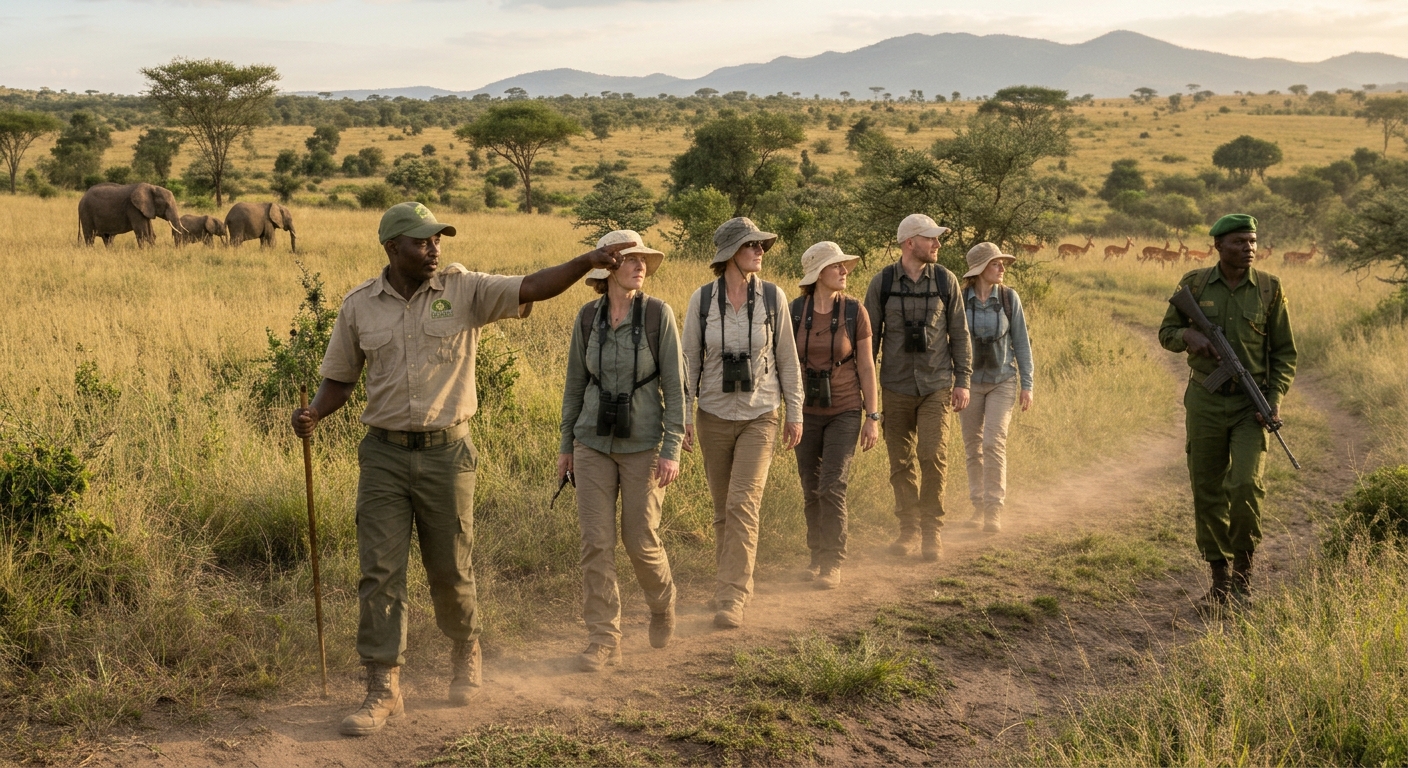
A game drive shows you more animals; a walking safari shows you more of how the bush works. On a game drive you cover large distances in a vehicle and have the best chance of seeing lions, elephants and the migration herds. On a walking safari you explore on foot with a qualified guide (and, in big-game areas, an armed ranger), usually for 2–4 hours, reading tracks, plants, birds and insects that you’d drive straight past. For most travellers the best answeris a safari built on game drives with one or two walks added in places that allow them.
This guide compares the two side by side: what you’ll see, how safe it is, how fit you need to be, what it costs and where in East Africa you can walk.
What is the difference between a walking safari and a game drive?
A game drive is the classic safari. You ride in a 4×4 or safari vehicle with a driver-guide, usually early in the morning and again in the late afternoon. Most of the animals are used to vehicles, so you can watch them at close range for long periods.
A walking safari (often called a bush walk or guided nature walk) means leaving the vehicle and exploring on foot. You walk in single file behind a guide, normally with an armed ranger, at a slow pace with frequent stops. The aim is to read the landscape, not to cover ground.
| Game drive | Walking safari | |
|---|---|---|
| Best for | Seeing big animals and covering ground | Detail, tracking, and an immersive feel |
| Typical length | Morning and afternoon drives, or a full day with a picnic lunch | About 2–4 hours, usually starting early in the morning |
| Distance covered | Tens of kilometres | A few kilometres at a slow pace |
| Big Five chances | High in good parks | Lower, and kept at a safe distance |
| Fitness needed | Very little | Moderate: uneven ground, heat, early starts |
| Age limits | Usually none at park level; some lodges set their own | Usually 12+ and often 16+, depending on the park and camp |
| Where allowed | Almost every park and reserve | Only in parks, conservancies and areas that permit walking |
| Extra cost | Normally built into your safari price | Often a separate activity fee, or included at some conservancy camps |
Will you see more wildlife on a game drive or on foot?
Game drives: more animals, more ground
If your priority is seeing lions, leopards, elephants, rhinos and the great herds, game drives win clearly. A vehicle can cover tens of kilometres in a morning, follow sightings, and get you to a river crossing or a lion kill in time. Animals in busy parks are used to vehicles and tend to carry on as normal, which is why you can sit with a pride of lions for an hour.
Game drives are also how you see the Great Migration. The herds move over huge distances, and you need wheels to keep up with them.
Walking safaris: the small things, up close
Your guide will show you how to read fresh tracks and dung, which plants local communities use as medicine, how termite mounds work, and which bird calls mean a predator is nearby. You hear and smell the bush in a way you can’t from a vehicle.
You may still see big animals such as giraffe, zebra, buffalo or elephant. But a good guide keeps a respectful distance from anything dangerous, and many animals move away from people on foot. Treat big-game sightings on a walk as a bonus, not the goal. If seeing a lion up close is what you want, do it from a vehicle.
Are walking safaris safe?
Walking safaris have a good safety record when they are run properly. That depends the right guides, the rules and you.
Who walks with you
- A qualified walking guide leads the group, reads animal behaviour and chooses the route. In Kenya, ask whether your guide is accredited by the Kenya Professional Safari Guides Association (KPSGA) at Silver or Gold level.
- An armed ranger walks with the group in most big-game areas. In Tanzania’s national parks and the Ngorongoro Conservation Area, walks are done with an armed park ranger. Kenya’s conservancies and Uganda’s Lake Mburo National Park also use armed rangers for walks in big-game country.
What the rules look like
Before you set off you’ll get a safety briefing. Expect these rules wherever you walk:
- Walk in single file and stay close behind the guide.
- Keep talking to a minimum and learn the hand signals.
- Never run, even if an animal comes towards you. Follow the guide’s instructions exactly.
- Stay on the route the guide chooses, and don’t wander off to take photos.
These rules are not a formality. Running from a predator can trigger a chase. The guide’s job is to avoid surprises in the first place, and yours is to make that job easy.
Rules about where you can walk
You can’t walk anywhere you like. Walking is not allowed in the Maasai Mara National Reserve, and most of Kenya’s national parks don’t allow walking safaris. It is allowed in the private and community conservancies that border the Mara, in many Laikipia conservancies, and in a few parks such as Hell’s Gate. In Tanzania, walks are run on approved routes in selected parks and need park permits. See where you can walk below.
How fit do you need to be for a walking safari?
You need to be comfortable on your feet.
- Distance and time: most walks last about 2–4 hours and cover a few kilometres at a slow pace with stops. Multi-day walking safaris are a different level. On some in northern Kenya, guests walk up to about five hours and roughly 15 km a day.
- Terrain: there are often no paths. Expect uneven, rocky or sandy ground, thorny bush and the occasional steep section. Crater walks such as Empakaai in the Ngorongoro highlands involve a steep climb back up.
- Heat and altitude: walks start early to avoid the midday heat, but it can still be hot and very sunny. Some areas, such as the Ngorongoro highlands, are high and cool in the morning.
- Footwear and clothing: wear closed walking shoes or light boots with good grip, long trousers against thorns, a hat and neutral-coloured clothes. Bring water and sunscreen.
Who walking safaris may not suit
- Travellers with limited mobility, knee or back problems, or heart conditions. Check with your doctor if you’re unsure.
- Young children. Tanzania’s park authorities set the minimum age for walking at 12, and many camps set it at 16. In Kenya, the camp or conservancy sets its own limit (some Laikipia camps, for example, set it at 16), so check before booking. Game drives are the better family option.
- Anyone who would feel anxious rather than excited on foot near wild animals. That’s a perfectly good reason to stay in the vehicle.
If you can’t walk, you’re not missing the safari. Game drives deliver the wildlife most people come for.
Is a walking safari more expensive than a game drive?
The walk itself is usually a modest add-on. The bigger cost difference comes from where you have to stay to do it.
Game drives are normally built into your safari price, through the vehicle, guide, fuel and park fees. Walking usually adds an activity fee, and sometimes a ranger fee as well. Here are some real published rates for international (non-resident) visitors:
| Where | Walking fee (non-resident adult) | Notes |
|---|---|---|
| Tanzania national parks (e.g. Tarangire, Arusha, Serengeti) | US$23.60 for a 1–4 hour walk; US$29.50 for longer walks | Plus a ranger/guide fee of about US$23.60 per group per day. Both include 18% VAT. Paid on top of park entry. |
| Ngorongoro Conservation Area (e.g. Empakaai, Olmoti) | US$23.60 for 1–4 hours; US$29.50 for over 4 hours | Paid on top of the Ngorongoro entry fee. |
| Ol Pejeta Conservancy, Laikipia (Kenya) | US$70 per adult for the guided bush/bird walk | On top of the conservancy entry fee of US$110 per non-resident adult in 2026. |
| Maasai Mara conservancies (Kenya) | Varies by camp: some include walks in the nightly rate, others charge extra | Conservancy camps usually cost more per night than lodges inside the national reserve. |
| Akagera National Park (Rwanda): “Walk the Line” | US$30 per adult | A 7 km, roughly 2-hour fence-line walk. It’s about conservation, not a big-game walk. |
What does that mean in practice? For a couple doing a short walk in Tarangire, the park walking fees come to about US$70.80 in total: 2 × US$23.60 per person plus one US$23.60 ranger fee. That’s around US$35 each, on top of the normal park entry.
The bigger cost is accommodation. In the Maasai Mara, for example, walking is only possible from the conservancies, and conservancy camps generally charge more per night than lodges inside the reserve. In return, you get fewer vehicles at sightings and activities the reserve doesn’t allow, such as walks and night drives, which some camps include in their rate.
When you compare quotes, ask:
- Is the walk included, or is it an optional extra?
- Are park walking fees and ranger fees included?
- How long is the walk, and who leads it: a park ranger, a camp guide or both?
- What is the minimum age, and can children do a shorter alternative?
Where can you do a walking safari in East Africa?
Walking rules differ by country, park and even camp, so it pays to know where walking is actually allowed before you fall for an itinerary.
Kenya
- Maasai Mara conservancies. Conservancies such as Mara North, Naboisho and Olare Motorogi allow guided walks, which are not permitted inside the national reserve. They’re the easiest way to add a walk to a classic Mara safari.
- Laikipia. This plateau of private and community conservancies is one of Kenya’s best areas for walking. Ol Pejeta Conservancy, for example, runs guided bush and bird walks.
- Amboseli area. Walking isn’t generally allowed inside Amboseli National Park, but some camps in the surrounding conservancies offer walks with views of Kilimanjaro.
- Hell’s Gate National Park. Near Lake Naivasha, this is one of the few Kenyan parks where walking and cycling are allowed. Big predators are rare here, but buffalo are present, and a guide is wise in the gorge, where flash floods can happen after rain.
Tanzania
- Arusha National Park. Ranger-led walks make it an easy add-on on the first or last day of a northern-circuit safari.
- Tarangire and the Serengeti. Walks run on approved routes with a park ranger, usually arranged through specific camps. Some Serengeti walking operators set the minimum age at 16.
- Ngorongoro highlands. Away from the main crater, walks to Empakaai and Olmoti craters offer volcanic scenery, highland forest and crater lakes, with an armed ranger.
- Nyerere (formerly Selous) and Ruaha. These remote southern parks have a long walking tradition and suit travellers who want a wilder trip.
Uganda
- Lake Mburo National Park. A compact savannah park where you can walk among zebra, eland and impala, escorted by an armed Uganda Wildlife Authority ranger.
Rwanda
- Akagera National Park offers the “Walk the Line” fence walk, but it’s a conservation experience rather than a big-game walk.
- Of course, gorilla trekking in Volcanoes National Park is itself a guided walk, often a steep one. If you want time on foot in Rwanda, that’s where it happens. Our gorilla trekking guide explains how it works.
For more on each country, see our Kenya destinations and Tanzania destinations guides.
Can you combine walking safaris and game drives?
Yes, and for most travellers this is the best option. A walk doesn’t replace your game drives; it slots in around them. A typical day looks like this:
- Early morning: a 2–3 hour walk while it’s cool, ending with breakfast back at camp or in the bush.
- Midday: rest at camp during the heat.
- Afternoon: a game drive to look for predators and big game, ending at sunset.
Here are three easy ways to build it into a trip:
- Mara reserve + conservancy (Kenya). Spend two nights inside the Maasai Mara National Reserve for big-game drives, then two nights in a neighbouring conservancy for a walk, fewer vehicles and night drives.
- Northern circuit with a walking warm-up (Tanzania). Start with a ranger-led walk in Arusha National Park, then game drives in Tarangire, the Serengeti and the Ngorongoro Crater. Add an Empakaai or Olmoti crater walk if you have an extra day.
- Laikipia then the Mara (Kenya). Two or three nights walking in Laikipia, then fly to the Mara for game drives and the migration in season.
Combining Kenya and Tanzania? Our guide to combined Kenya and Tanzania safaris explains how to fit both countries into one trip.
Walking safari or game drive: which should you choose?
Choose game drives as the core of your safari if:
- It’s your first safari and you want the best chance of seeing the Big Five
- You’re coming for the Great Migration
- You’re travelling with young children
- You have limited mobility, or long walks in the heat don’t appeal
Add a walking safari, or build your trip around walking, if:
- You’ve done a safari before and want something different
- You love birds, plants, tracking or photography of the small details
- You want to feel part of the landscape rather than watch it through a window
- You’re reasonably fit and comfortable on uneven ground
Our honest advice: for most people, the answer is both. Build the safari around game drives, then add one or two walks in a conservancy or a park that allows them. It often costs less than you’d expect.
Frequently asked questions
Can you do a walking safari in the Maasai Mara?
Not inside the Maasai Mara National Reserve, where walking isn’t permitted. You can walk in the private and community conservancies that border the reserve, such as Mara North, Naboisho and Olare Motorogi, usually with an armed ranger and a trained guide.
Do you see the Big Five on a walking safari?
Sometimes, but it isn’t the aim. Guides keep a safe distance from dangerous animals, and many animals move away from people on foot. Walks focus on tracks, plants, birds and smaller wildlife. Game drives are the best way to see the Big Five.
What is the minimum age for a walking safari?
It depends on the park and camp. Tanzania’s park rules allow walking from age 12, and many camps in Kenya and Tanzania set the minimum at 16. Always check the specific camp’s policy before booking.
How much does a walking safari cost?
In Tanzania’s national parks, a 1–4 hour walk costs US$23.60 per adult plus a ranger fee of about US$23.60 per group. Ol Pejeta in Kenya charges US$70 per adult for its guided bush walk. In the Mara conservancies, some camps include walks in the nightly rate and others charge extra.
Can you do a walking safari and game drives on the same trip?
Yes. The usual pattern is a walk in the early morning and a game drive in the afternoon. Many itineraries combine national-reserve nights for game drives with conservancy nights for walking.
Not sure which mix suits you?
Tell us your travel dates, who’s coming and how active you’d like the trip to be. We’ll suggest where a walk fits in, or whether game drives alone are the better choice for you. You can also browse our Kenya and Tanzania safari packages for ideas.